In the dry scrubland of southern Haryana, where the northernmost spurs of the Aravallis dissolve into the plains of Rewari and Mahendragarh, history keeps an appointment with November. Twice in just over a century—first in the closing phase of the 1857 uprising, and again amid the Himalayan frost of 1962—men from the villages of Ahirwal stood their ground against overwhelming military force within forty-eight hours of the same calendar window. Neither engagement yielded an easy victory. Yet both reshaped India’s memory of resistance, binding South Haryana’s plains to Rajasthan’s deserts in a shared ledger of command and sacrifice.
The sandy plains of Nasibpur, November 1857
When rebellion erupted in May 1857, Rao Tula Ram, the young chieftain of Rewari, moved with his cousin Rao Gopal Dev to depose the East India Company’s local administration and raise roughly 5,000 troops. Operating from Rampura near Rewari, he set up an ordnance workshop and sent ₹45,000 along with 2,000 sacks of wheat to Delhi via General Bakht Khan days before the imperial capital fell on September 21, 1857.
Once Delhi was retaken, the British dispatched a Moveable Column of around 1,500 men on November 10 under Colonel John Grant Gerrard to crush resistance south-west of Delhi. With neighbouring states such as Jaipur, Alwar, Pataudi, and Loharu aligned with the Company, Tula Ram’s position was precarious. Yet he did not fight alone. At the sandy village of Nasibpur near Narnaul on November 16, 1857—on the cusp of that mid-November window—Gerrard’s column was met by Ahirwal levies, Jhajjar cavalry, and battle-hardened mutineers from Rajasthan.
The opening rebel charge struck with such ferocity that the British right flank—Patiala Infantry and Multani Horse—buckled and fled. In the thick of the fight, Colonel Gerrard, conspicuous in his red coat among khaki-clad troops, was mortally wounded by musket fire alongside Captain Wallace, while several British officers fell injured. Only the counter-attack of the Guides and Carabineers under Captain Caulfield saved the column and forced a rebel retreat. Rao Tula Ram later joined Tantia Tope in Rajasthan before travelling through Persia and Afghanistan to seek foreign allies, dying in exile in Kabul in September 1863 at age thirty-eight.
Two mid-November campaigns separated by 105 years linked Rajasthan and Ahirwal1857 ·
The Rajputana axis: From Auwa to Rewari
What elevates Nasibpur beyond a local Haryana uprising is the interstate coalition that converged there. In August 1857, the Jodhpur Legion—raised out of Marwar’s treaty tribute and stationed at Erinpura—mutinied against British officers with the cry “Chalo Delhi, Maro Firangi.”
Marching north, the Legion joined Thakur Kushal Singh Champawat of Auwa, who defied both the British Political Agent and Maharaja Takht Singh of Jodhpur. Backed by the thakurs of Asop, Gular, and Alaniyawas, the rebels defeated state and Company forces at Bithora on September 8 and at Chelawas on September 18, where Political Agent Monck Mason was killed. When differences later separated Kushal Singh from the sepoys, the Legion—with Thakur Shivnath Singh of Asop, Bishan Singh of Gular, and Ajit Singh of Alaniyawas—marched north, defeated loyalist Jaipur troops, helped reoccupy Rewari, and joined Rao Tula Ram at Nasibpur for its final stand.
18,000 feet above: Rezang La, November 18, 1962
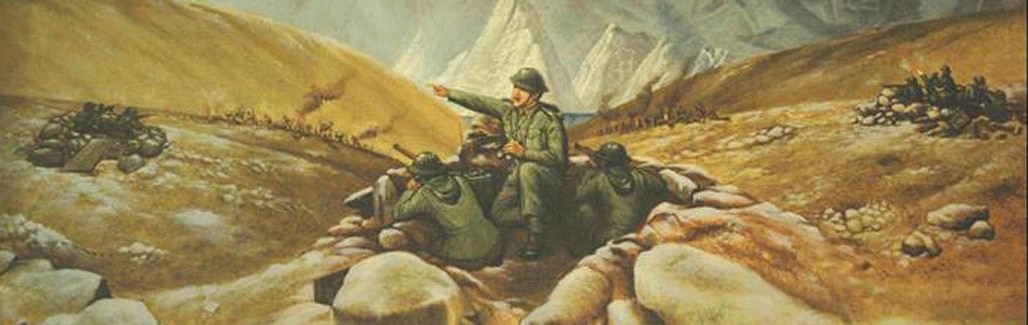
One hundred and five years and two days after Nasibpur, the descendants of that same Ahirwal belt—drawn overwhelmingly from Rewari, Mahendragarh, and Gurgaon—held a wind-scoured ridge in eastern Ladakh. As The Hindu has chronicled, C Company of 13 Kumaon, an all-Ahir unit of roughly 120 soldiers, defended Rezang La at 16,000 to 18,000 feet to guard the Chushul airfield.
Spread across Posts 7, 8, and 9 and screened from Indian artillery by an intervening ridge, C Company was hit at dawn on November 18, 1962 by waves of the Chinese People’s Liberation Army (3rd Battalion, 11th Infantry Regiment) backed by mortars and recoilless guns. Armed with .303 Lee-Enfield rifles in sub-zero cold, the Ahirwal jawans repulsed repeated assaults until ammunition ran dry and fighting turned hand-to-hand. Official accounts cited by The Hindu and the Press Information Bureau record that 114 of the 120 soldiers fell at their posts. When snows melted in early 1963, Brigadier T.N. Raina’s party found them frozen in their trenches, weapons still aimed at the enemy.

The officer from Jodhpur
At the centre of that frozen stand was Major Shaitan Singh Bhati, a Rajput born in Banasar in Jodhpur State, Rajasthan—the very Marwar heartland whose rebel legion had ridden to Rao Tula Ram’s side a century earlier. Commissioned into the Jodhpur State Forces in 1949 before transferring to the Kumaon Regiment, Major Singh moved unprotected between posts under heavy fire, steadying his platoons. Gravely wounded in the arms and abdomen, he refused evacuation, ordering two jawans to leave him and save themselves.
Major Shaitan Singh received the Param Vir Chakra posthumously, while his men earned eight Vir Chakras, four Sena Medals, and one Mention-in-Despatches. C Company was later rechristened ‘Rezang La Company’, and 13 Kumaon earned the Battle Honour Rezang La and Theatre Honour Ladakh.
“In 1857, Marwar’s rebel cavalry rode north to stand with Ahirwal at Nasibpur; in 1962, a Rajput son of Jodhpur led Ahirwal’s infantry into immortality at Rezang La.”A century-long martial bond between Rajasthan and South Haryana
Two Novembers in the ledger
Across different weapons, terrain, and eras, Nasibpur and Rezang La show how regional solidarity anchors India’s military memory.
| Dimension | Battle of Nasibpur | Battle of Rezang La |
|---|---|---|
| Date | 16 Nov 1857 | 18 Nov 1962 |
| Terrain | Sandy plains near Narnaul, South Haryana | 16,000–18,000 ft ridge, Chushul, Ladakh |
| Ahirwal force | ~5,000 levies under Rao Tula Ram | ~120 soldiers of C Company, 13 Kumaon |
| Rajasthan link | Jodhpur Legion & Marwar thakurs (Auwa, Asop) | Led by Major Shaitan Singh Bhati (Jodhpur, PVC) |
| Adversary | British column (~1,500); Col. Gerrard killed | Chinese PLA 3rd Bn, 11th Regt (reinforced) |
| Outcome | Retreat; Tula Ram died in Kabul (1863) | 114 killed; 1 PVC, 8 VrC, 4 SM; Chushul saved |
Memory beyond November
For decades, as commentators in The Hindu have observed, both battles lived vividly in the folk memory of Rewari and Mahendragarh even when absent from textbooks. Today, memorials in Narnaul, Rewari, Gurugram, and the renovated Rezang La War Memorial at Chushul preserve their names—a reminder that November in Ahirwal is a recurring measure of resolve.
